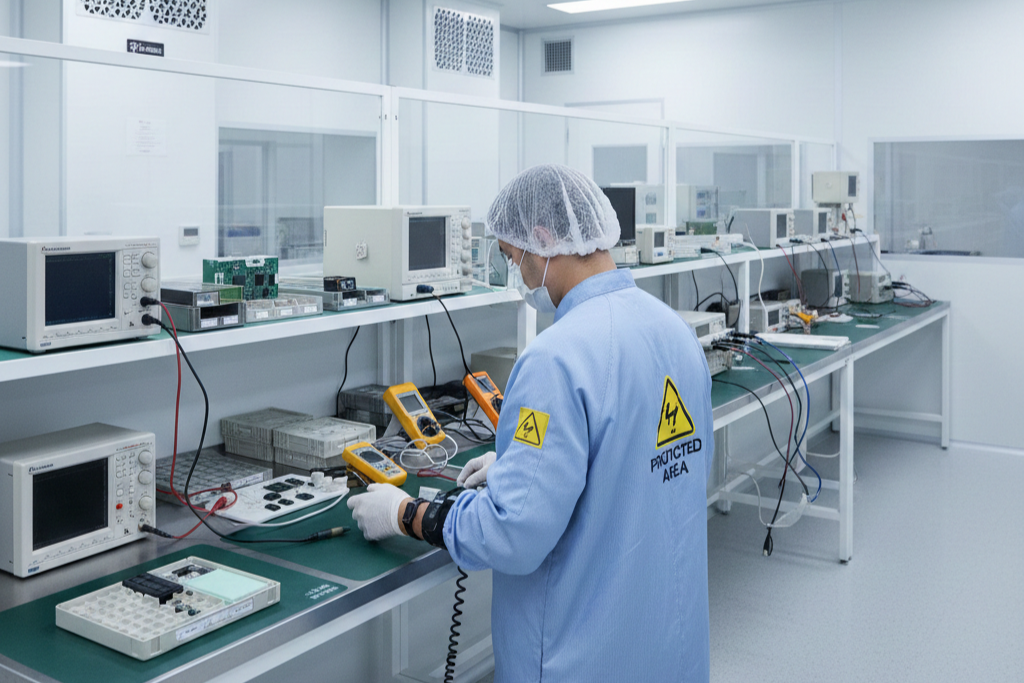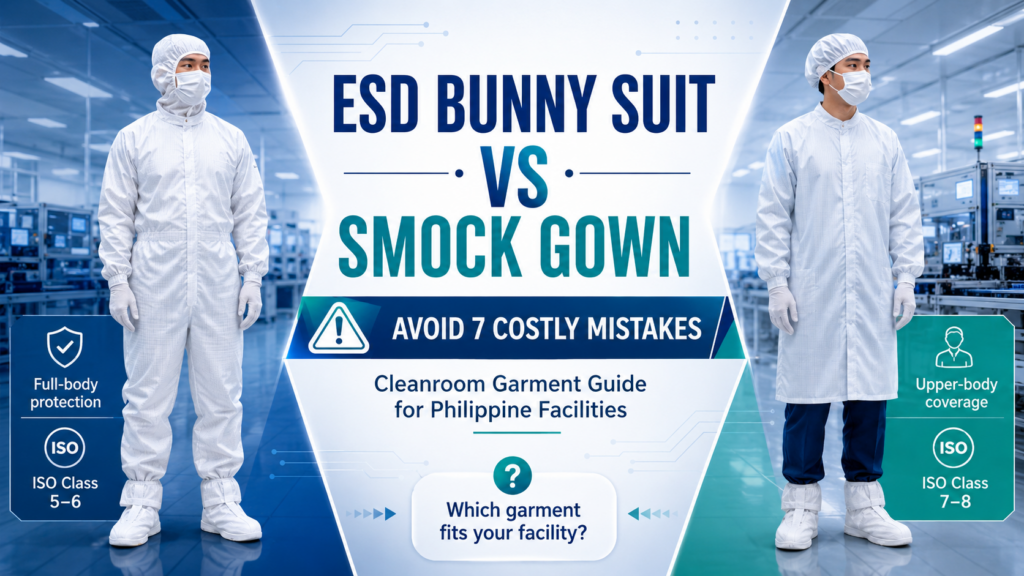

Cleanroom apparel — ESD-safe bunny suits, smocks, booties, and head caps — protects semiconductor yield from static discharge and airborne particles while meeting the PPE mandate under RA 11058. For Philippine assembly, test, and packaging (ATP) plants competing inside a nearly $50-billion export industry, the garment system on the production floor is a production safeguard, not a uniform line item.
The Philippines Has Too Much Riding on This Industry to Get Gowning Wrong
Semiconductor and electronics products are the single largest category in Philippine exports. The Semiconductor and Electronics Industries in the Philippines Foundation (SEIPI) reported that electronics exports jumped 16% to $49.64 billion in 2025, and industry leaders now expect the country to clear the $50-billion mark in 2026 — potentially reaching $53–54 billion. The Philippines is the world’s ninth-largest chip exporter and holds roughly 5% of the global semiconductor market, built almost entirely on assembly, test, and packaging (ATP) work rather than front-end wafer fabrication.
That ATP specialization is concentrated in CALABARZON. Facilities from Amkor Technology, Analog Devices, onsemi, Texas Instruments, Integrated Micro-Electronics (IMI), and PSi Technologies operate out of Laguna Technopark, Gateway Business Park in General Trias, Cavite, and Carmelray Industrial Park in Calamba, Laguna — the same economic zones where NuPon Apparel already has branch coverage (Laguna, Cavite, Batangas, Clark, Subic, Manila, Cebu, Baguio). This is industry context, not a client list — but it’s the backyard NuPon Apparel is built to serve.
Every one of these operations lives or dies on two invisible threats: particles you can’t see landing on a wafer, and static charges you can’t feel destroying a chip. Apparel is the last line of defense against both.
Two Invisible Threats Every Semiconductor Cleanroom Has to Control
1. Airborne Particle Contamination — Governed by ISO 14644-1
Cleanroom classification under ISO 14644-1 sets the maximum number of airborne particles permitted per cubic meter of air, running from the ultra-clean ISO Class 1–3 environments used in advanced semiconductor work down to the more forgiving ISO Class 8–9. People are the dominant particle source in any classified space — shedding skin cells, fibers, and cosmetics at rates that spike with movement and drop with garment coverage. That’s why gowning requirements scale directly with class: wafer fabrication and photolithography areas typically call for full-body cleanroom suits donned in a sequenced gowning room, while a less stringent ISO 8 support area may only need a coat and head covering.
Gowning procedure matters as much as garment selection. A correctly specified suit put on incorrectly, or a torn boot cover at the gowning line, contributes almost nothing to contamination control — which is why standardized, well-fitted garment systems matter more in high-volume, multi-shift PEZA operations than in a single-shift lab.
2. Electrostatic Discharge — Governed by ANSI/ESD S20.20
Modern chips operate at voltages low enough that static most workers can’t even feel is enough to destroy them. Component-level damage can start at single-digit voltages, and the ESD Association estimates ESD-related failures account for up to a third of all field failures in electronics manufacturing, with industry-wide losses estimated in the billions of dollars a year — some estimates run into the tens of billions as the global semiconductor market has grown past the trillion-dollar mark. Much of that damage is latent: a component passes initial testing, ships, and fails months later in the field — the costliest and hardest-to-trace kind of defect.
ESD garment systems built to ANSI/ESD S20.20 (or the international IEC 61340-5-1 equivalent) use conductive fibers woven through the fabric to keep surface resistivity in the dissipative range, safely bleeding off static charge instead of letting it build up during chip handling, testing, and micro-assembly.
What Philippine Law Already Requires — and Why That’s the Floor, Not the Ceiling
Under Section 8 of RA 11058 (the Occupational Safety and Health Standards Law), every employer must furnish workers appropriate personal protective equipment, free of charge, based on the hazards of the job and the recommendation of the company’s safety officer. The 2025 revised implementing rules, DOLE Department Order No. 252-25, sharpened enforcement further — giving labor inspectors clearer authority to order an immediate work stoppage and introducing steeper progressive fines for repeated non-compliance.
For a semiconductor ATP plant, contamination-control and ESD apparel isn’t a separate “nice to have” safety category — it is the PPE the law already requires for that hazard class. But most PEZA-zone semiconductor operations answer to a second layer of scrutiny on top of DOLE: the OEM or IDM client’s own supplier audit, which typically checks garment specification, CE marking, and documented ESD compliance as a condition of keeping the account. A garment program built around recognized standards satisfies both requirements at once, instead of treating them as two separate boxes to check.
The Garment System a Semiconductor Gowning Line Actually Needs
| Cleanroom Zone | What It Needs | Primary Risk Controlled |
|---|---|---|
| Wafer fabrication & photolithography | Full-body ESD bunny suits (with or without hood), ESD hoods with facemasks | Particle shedding |
| Chip assembly & micro-testing | ESD smock gowns, anti-static ESD lab gowns, ESD pants, ESD jackets | Static discharge during handling |
| Gowning & cleanroom entry points | ESD head caps, ESD facemasks, ESD booties (ampalaya sole, conductive sole, or tarpaulin sole) | Cross-contamination at transition zones |
| Support & utility areas (non-classified) | Structured industrial uniforms, anti-static aprons | General workforce consistency and safety |
NuPon Apparel manufactures this full stack — ESD bunny suits, ESD smock gowns, anti-static ESD lab gowns, ESD jackets and pants, ESD hoods and head caps, ESD facemasks, ESD booties across sole types, anti-static aprons, ESD bags, and the supporting industrial uniform lines — as CE certified garment solutions manufactured in the Philippines, not imported and re-sold.
Why Local Manufacturing Is the Differentiator, Not Just the Origin Story
Semiconductor ATP lines run multi-shift, and gowning consumables — booties, facemasks, disposable liners — get replenished daily, not quarterly. A manufacturer headquartered in Santa Rosa City, Laguna, with branch coverage across Cavite, Batangas, Clark, Subic, Manila, Cebu, and Baguio, can turn around replenishment and customization orders on a timeline an overseas cleanroom-apparel importer simply can’t match — a real advantage when a gowning-room stockout means a line stoppage, not just an inconvenience.
Frequently Asked Questions
Why is cleanroom apparel important for the semiconductor industry?
Cleanroom apparel controls the two contamination sources semiconductor manufacturing can’t tolerate: airborne particles that damage wafer yield, and electrostatic discharge that destroys sensitive components. ESD-related failures alone are estimated to cost the global electronics industry billions of dollars a year, making garment compliance a direct yield and cost issue, not just a safety formality.
What standards should semiconductor cleanroom garments meet?
Garments should align with ISO 14644-1 for particle-count classification and ANSI/ESD S20.20 (or IEC 61340-5-1) for static-dissipative performance. Many Philippine ATP plants also require CE certification as part of their OEM or IDM client’s supplier audit.
Is cleanroom or ESD apparel legally required in the Philippines?
Yes. Section 8 of RA 11058 requires employers to provide appropriate PPE, free of charge, based on workplace hazards and the safety officer’s assessment. DOLE Department Order No. 252-25 (2025) strengthened enforcement and penalties for non-compliance.
What garments does a semiconductor cleanroom actually need?
A typical gowning line includes ESD bunny suits or smock gowns for the classified cleanroom, ESD hoods, head caps, and facemasks at gowning stations, ESD booties in various sole types, and anti-static aprons or lab gowns for handling and testing zones.
Why choose a Philippine-manufactured supplier over an imported one?
Semiconductor gowning consumables are used daily, not quarterly. A locally manufactured, CE certified supplier with branch coverage across the CALABARZON and Luzon economic zones can replenish and customize orders on a timeline that protects against gowning-room stockouts — something overseas suppliers on long shipping lead times often can’t guarantee.
Upgrade Your Semiconductor Cleanroom Apparel System
NuPon Apparel manufactures CE certified cleanroom and ESD garment systems in the Philippines, built for the contamination-control and static-safety standards semiconductor ATP operations run on. Request a consultation or explore the full Cleanroom Garments line.