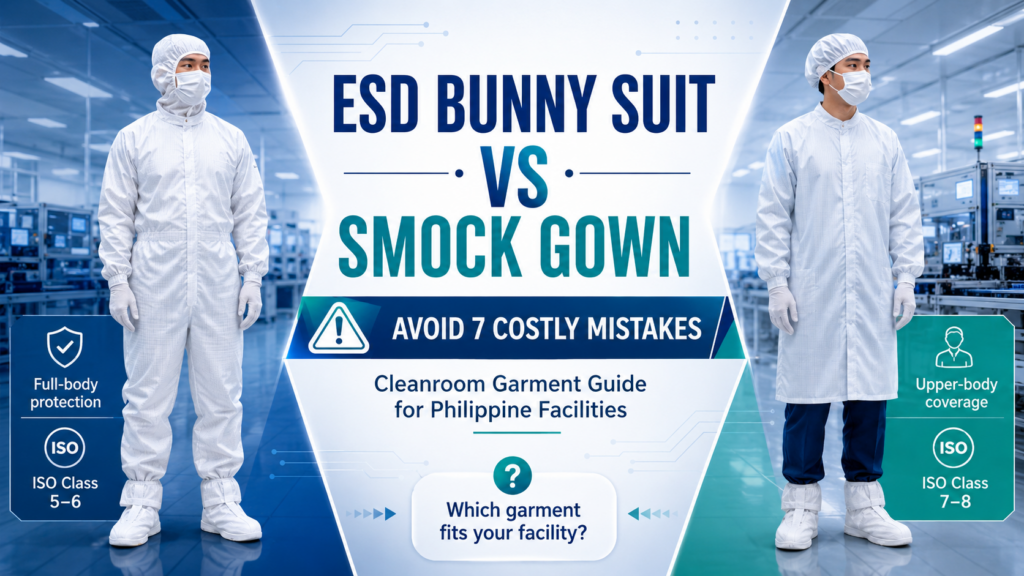
Quick Answer: Choose an ESD bunny suit for ISO Class 5–6 cleanrooms (semiconductor wafer fab, IC assembly, advanced packaging). Choose an ESD smock gown for ISO Class 7–8 environments (general electronics assembly, pharmaceutical lines, food processing, automotive). Your cleanroom classification and the ESD sensitivity rating of your components are the two primary deciding factors.
If you manage ESD compliance or procurement for a Philippine electronics, semiconductor, or pharmaceutical facility — and you’ve ever debated whether to outfit your team in full coveralls or smock gowns — this guide is for you.
Both garments provide electrostatic discharge protection. Both comply with ANSI/ESD S20.20 and IEC 61340-5-1. But they are not interchangeable. Getting this decision wrong means either over-engineering your gowning program (adding cost and time) or under-protecting your products (risking ESD damage and yield loss).
Below is a definitive comparison — built on ISO 14644-1 cleanroom standards, ANSI/ESD guidelines, and real-world application data from Philippine PEZA manufacturing facilities.
What Is an ESD Bunny Suit?
An ESD bunny suit — also called an ESD coverall or cleanroom coverall — is a full-body, one-piece anti-static garment that encapsulates the wearer from shoulders to ankles in a single continuous piece of anti-static fabric. It is the standard gowning garment for ISO Class 5–6 cleanrooms in semiconductor fabrication and advanced electronics manufacturing.
Definition: An ESD bunny suit is a full-coverage, one-piece anti-static cleanroom coverall worn over all clothing. Made from continuous filament polyester fabric with ESD properties, it dissipates electrostatic charge from the body surface while providing a particle barrier. Combined with an ESD hood, ESD booties, ESD gloves, and a facemask, it forms the complete gowning system for ISO Class 5–6 cleanrooms.
Key Specifications and Features
- Coverage: Full body — torso, arms, and legs in one integrated piece
- Primary fabric: Anti-static continuous filament polyester (lower static retention vs. nylon; better resistance to yellowing)
- Hood variants: Available with integrated hood or without hood (worn with a separate ESD hood)
- Resistance to ground: ≤109 ohms per ANSI ESD STM 2.1 (as tested against ground point)
- Cleanroom class: ISO Class 1–6 (most common application: ISO Class 5–6)
- Customization available: Fabric type (TC Rayon / Anti-Static / Anti-Acid), color, company logo embroidery or printing
NuPon Apparel manufactures ESD bunny suits with and without hoods at its production facility in Santa Rosa City, Laguna — supplying PEZA-registered semiconductor and electronics companies across CALABARZON, Baguio, Clark, Subic, Cebu, and Manila.
→ View NuPon Apparel ESD Bunny Suit specifications
What Is an ESD Smock Gown?
An ESD smock gown is a partial-body anti-static garment that covers the upper body, torso, and arms. Unlike the bunny suit, it does not cover the legs. It is the most widely used ESD garment in Philippine electronics assembly plants, pharmaceutical manufacturing lines, food processing facilities, and automotive component assembly areas.
Definition: An ESD smock gown is a knee-length or mid-thigh anti-static garment that covers the upper body and arms. It provides electrostatic discharge protection for ISO Class 7–8 environments, general electronics assembly areas, and production floors where full-body particle control is not required. It is typically worn over standard work clothes with an ESD head cap and ESD booties.
Key Specifications and Features
- Coverage: Upper body and arms — does not cover legs
- Length: Knee-length or mid-thigh (depending on design)
- Hood variants: Long sleeve (standard) / Long sleeve with integrated hood
- Gowning speed: Significantly faster to don and doff than full coveralls — reduces gowning area congestion on multi-shift operations
- Cost per unit: Lower than bunny suit — less fabric, simpler construction
- Cleanroom class: ISO Class 7–8 (most common application)
- Resistance to ground: ≤109 ohms per ANSI ESD STM 2.1
→ View NuPon Apparel ESD Smock Gown specifications
ESD Bunny Suit vs. ESD Smock Gown: Full Comparison
Use this side-by-side table to evaluate which garment matches your facility’s requirements.
| Feature | ESD Bunny Suit (Coverall) | ESD Smock Gown |
|---|---|---|
| Body Coverage | Full body — torso, arms, and legs | Upper body and arms only |
| ISO Cleanroom Class | ISO Class 1–6 (most common: Class 5–6) | ISO Class 7–8 |
| Primary Industry Use (PH) | Semiconductor fab, IC assembly, advanced packaging | Electronics assembly, pharma, food processing, automotive |
| Particle Control Level | Maximum — whole-body particle barrier | Moderate — upper-body control only |
| ESD Control Level | High — full-body electrostatic dissipation | Moderate — upper body and arms |
| HBM Sensitivity Range | HBM Class 0 and 1A (most sensitive: <500V) | HBM Class 1B and above (500V+) |
| Gowning Time | Longer — full gowning protocol required | Faster — quicker to don and doff |
| Cost Per Unit | Higher (more material, more complex construction) | Lower (less material, simpler) |
| Required Accessories | ESD hood, ESD booties, ESD gloves, ESD facemask | ESD head cap, ESD booties (gloves optional) |
| Variants (NuPon Apparel) | With hood / Without hood | Long sleeve / Long sleeve with hood |
| Applicable Standard | ANSI/ESD S20.20, IEC 61340-5-1, ISO 14644-1 | ANSI/ESD S20.20, IEC 61340-5-1, ISO 14644-1 |
When Should You Use an ESD Bunny Suit?
Use an ESD bunny suit when: your cleanroom is classified at ISO Class 6 or cleaner, when you handle components sensitive below 500V (HBM Class 0 or 1A), when your facility conducts formal third-party cleanroom audits, or when you operate in semiconductor wafer fabrication or advanced packaging environments.
1. Your Cleanroom Is Classified ISO Class 5–6 or Cleaner
Under ISO 14644-1, cleanrooms at ISO Class 6 or stricter require full-body personnel contamination control. At these levels, the lower body — specifically, trouser legs, which generate millions of particles per minute during walking — becomes a major vector for contamination. A standard smock gown leaves this particle source uncontrolled. An ESD bunny suit, worn with ESD booties, seals the full body in a continuous ESD and particle-controlling envelope.
2. You Handle Highly ESD-Sensitive Components (HBM Class 0 or 1A)
Components classified at Human Body Model (HBM) Class 0 (below 250V) or HBM Class 1A (250–500V) per ANSI/ESD S20.20 require the highest level of body voltage control at every production step. Since standard trousers can generate thousands of volts of static — especially in air-conditioned environments — full-body ESD coverage is necessary. A smock gown alone leaves the legs as an ungrounded, charge-generating surface.
3. Semiconductor Wafer Fabrication and Advanced Packaging Operations
The Philippines is the world’s 9th largest chip exporter, with the CALABARZON region hosting the country’s highest concentration of semiconductor assembly, test, and packaging facilities. Front-end wafer fabrication and sub-7nm IC assembly universally require full-coverall ESD bunny suit gowning systems. This is non-negotiable under most international semiconductor customer audits and process specifications.
4. Your Facility Is Subject to Third-Party Cleanroom or ESD Audits
If your plant is audited against IPC-7711/7721, IATF 16949, ISO 13485 (medical devices), or customer-specific ESD control programs, a full bunny suit gowning system provides the level of documented ESD and contamination control expected at a formal audit. Smock gowns may not satisfy audit checklists for facilities targeting ISO Class 5–6 certification.
When Should You Use an ESD Smock Gown?
Use an ESD smock gown when: your production floor is classified ISO Class 7–8 or is a non-rated controlled area, when you handle components at HBM Class 1B and above (500V+), when your operation runs multiple shifts requiring fast gowning transitions, or when you work in pharmaceutical, food processing, or automotive environments where upper-body hygiene and moderate ESD control are the primary requirements.
1. Your Work Area Is ISO Class 7–8 or a Controlled Non-Rated Floor
ISO Class 7 allows up to 352,000 particles ≥0.5μm per cubic meter; Class 8 allows up to 3,520,000 particles per cubic meter. At these levels, full-body contamination control is not required — upper-body control through a smock gown, combined with an ESD head cap and ESD booties, meets the cleanliness and static control requirements of most general electronics assembly environments in the Philippines.
2. Your Components Are Rated HBM Class 1B or Higher
For components at HBM Class 1B (500–1,000V), Class 2 (1,000–2,000V), or Class 3A/3B (above 2,000V), a properly grounded ESD smock gown worn with grounded ESD booties on a conductive or dissipative floor provides sufficient body voltage control to protect the product under ANSI/ESD S20.20 guidelines. The residual static from unprotected trouser legs is not a significant risk at these sensitivity levels when other ESD controls (wristbands, mats, floors) are in place.
3. High-Volume, Multi-Shift Electronics Assembly Operations
In three-shift electronics assembly plants where hundreds of workers change gowning in a limited space, smock gowns save measurable time per shift transition. Faster gowning reduces bottlenecks at gowning rooms, lowers non-productive time per worker, and reduces the operational complexity of garment management. For many PEZA electronics assembly locators in CALABARZON, smock gowns provide the right balance of protection and efficiency.
4. Pharmaceutical, Food Processing, and Automotive Environments
For pharmaceutical manufacturing under WHO-GMP or DOH guidelines, food processing under FDA/BFAD contamination control requirements, and automotive assembly of electronic components, the primary goals are upper-body hygiene, cross-contamination prevention, and moderate static control. ESD smock gowns, optionally in anti-acid fabric for chemical-exposure environments, are the correct garment choice across these industries.
Philippine Industry Use Cases: Which Garment for Which Sector?
The Philippines hosts over 2,022 PEZA locator companies across 61 economic zones in CALABARZON alone — including major electronics and semiconductor manufacturers in Laguna, Cavite, and Batangas. The following table maps typical Philippine manufacturing environments to their standard ESD gowning requirements.
| Industry | Typical ISO Class | Recommended Garment | Accessories Needed |
|---|---|---|---|
| Semiconductor Wafer Fab / IC Assembly | ISO Class 3–6 | ESD Bunny Suit (with hood) | ESD hood, booties, gloves, facemask |
| Semiconductor Back-End Assembly & Test | ISO Class 6–7 | Bunny Suit or Smock Gown* | Hood or head cap, booties, gloves |
| Electronics Assembly (PCBA) | ISO Class 7–8 | ESD Smock Gown | ESD head cap, ESD booties |
| Medical Device Manufacturing | ISO Class 5–7 | Bunny Suit (ISO 5) or Smock Gown (ISO 7)* | Full gowning (ISO 5) or cap + booties (ISO 7) |
| Pharmaceutical Manufacturing (GMP) | ISO Class 5–8 | Bunny Suit (sterile) or Smock Gown* | Hood, booties, facemask |
| Food Processing | Controlled (non-ISO rated) | ESD Smock Gown / Anti-Static Apron | ESD head cap, booties, facemask |
| Automotive Electronics Assembly | Controlled (non-ISO rated) | ESD Smock Gown or ESD Jacket | ESD head cap, booties (in component areas) |
*Garment choice depends on component ESD sensitivity (HBM classification) and facility-specific ESD control program requirements. Always consult your ESD coordinator and refer to your facility’s ESD Control Plan in accordance with ANSI/ESD S20.20.
Decision Framework: 4 Questions to Determine the Right ESD Garment
Answer these four questions to determine whether your facility needs an ESD bunny suit or ESD smock gown.
- What is your cleanroom ISO classification?
ISO Class 1–6 → ESD Bunny Suit is required.
ISO Class 7–8 or non-rated → ESD Smock Gown is typically sufficient. - What is the HBM ESD sensitivity class of your most sensitive component?
HBM Class 0 or 1A (below 500V) → ESD Bunny Suit recommended.
HBM Class 1B and above (500V+) → ESD Smock Gown with proper grounding. - Does your facility undergo formal third-party cleanroom or ESD audits?
Yes (semiconductor customer, ISO 13485, IATF) → ESD Bunny Suit provides greater audit compliance assurance.
No formal audits / internal program only → Either garment, depending on Questions 1–2. - What are your operational constraints?
Consider: shift frequency, number of workers, gowning room size, and budget per garment. Smock gowns provide measurable time and cost savings in high-volume, multi-shift operations where bunny suits are not required by ISO class.
Need help choosing the right ESD garment for your facility?
NuPon Apparel’s team can recommend the right garment based on your cleanroom class, ESD program, and order volume. We manufacture locally in Santa Rosa, Laguna, with delivery to all PEZA zones nationwide.
Request a Free Quote or Sample Kit →